On-Page SEO Services That Rank on Google and Get Cited by AI
If your pages are not ranking where they should, the issue is often not your industry or competition. It is what is happening directly on your page.
On-page SEO ensures every element of your content sends the right signals to search engines and AI systems. When optimized properly, your page becomes easier for Google to understand, more persuasive to visitors, and more likely to be cited by tools like Google AI Overviews, ChatGPT, and Perplexity.
This service helps you turn existing pages into structured, high-performing assets that rank, get clicked, and support long-term visibility.
What On-Page SEO Does for Your Business
You may already have good content. But without proper structure, targeting, and optimization, it may never reach its full potential.
With a focused on-page SEO strategy, you can:
- Improve rankings for keywords that directly impact your revenue
- Increase click-through rates with optimized titles and meta descriptions
- Align each page with clear search intent
- Improve readability and engagement with clean structure
- Position your content to appear in AI Overviews and LLM-generated answers
Instead of creating more content, you make your current pages work harder and perform better.
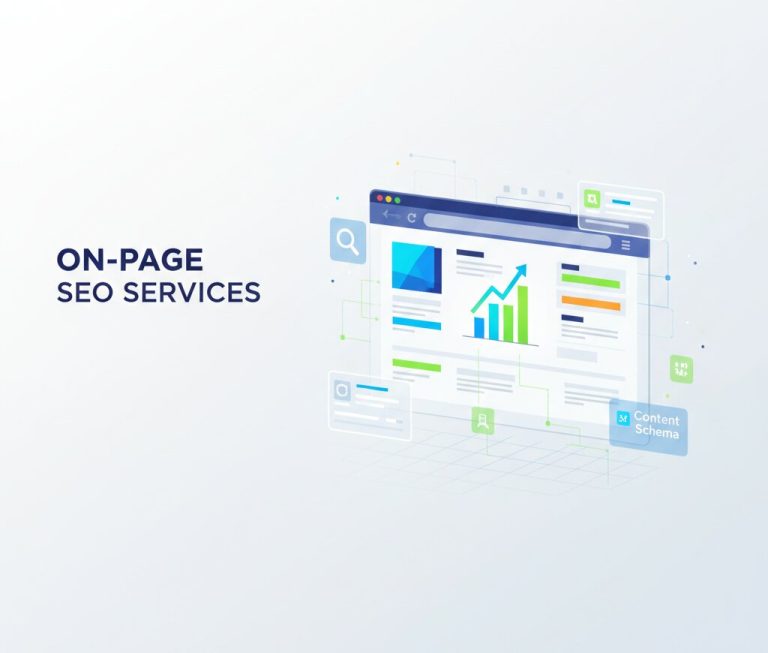
What You Get With This On-Page SEO Service
You receive a detailed, page-level optimization plan built around your keywords, your audience, and your business goals.
Every recommendation is practical and ready to implement. This service includes:
- Title tag and meta description optimization
- Header structure refinement for clarity and keyword alignment
- Content optimization based on search intent
- Internal linking recommendations to strengthen authority
- Image alt text and URL structure review
- Technical on-page improvements
- Generative Engine Optimization (GEO) enhancements so AI systems can understand and cite your content
Every adjustment serves a purpose: improve visibility, strengthen engagement, and increase your chances of being surfaced in both traditional and AI-driven search results.
How the On-Page SEO Process Works
Step 1: Audit Your Existing Pages
We review your current on-page elements to identify what is helping, what is hurting, and what is missing entirely—including signals that matter for AI-generated results.
Step 2: Align With Search Intent
Each page is evaluated against the intent behind its target keyword to make sure your content meets what users actually expect to find, whether they search via traditional results or through an AI-powered answer.
Step 3: Optimize On-Page Elements
Titles, headers, meta descriptions, body content, and supporting elements are refined so every signal on the page is working toward the same goal.
Step 4: Structure Content for AI Visibility
This is where most SEO services stop short. We go further by structuring your content so it answers questions directly, uses clear definitions, and presents information in a format that AI Overviews and LLMs can parse, cite, and attribute to your page.
Step 5: Strengthen Internal Links
We map out internal linking opportunities that distribute authority across your site and guide visitors toward your most important pages.
Step 6: Deliver Clear Implementation Plan
You receive a prioritized list of actionable recommendations. If you prefer, implementation can be handled for you.
Why On-Page SEO Now Includes AI Optimization
Search has changed. Google’s AI Overviews now appear at the top of millions of search results, summarizing answers before a user ever scrolls to the blue links. ChatGPT, Perplexity, and other AI tools are also being used to research services, compare providers, and find recommendations.
If your pages are not structured to be understood and cited by these systems, you are invisible to a growing portion of your potential customers—even if you rank on page one.
The good news is that the fundamentals of strong on-page SEO and AI visibility overlap more than most people realize. Pages that are clear, well-structured, authoritative, and directly answer specific questions are exactly what both Google and AI systems reward. The difference is in how deliberately you build for both.
Optimizing for AI Overviews and LLMs means:
- Writing content that directly answers the questions your audience is asking, not just targeting keywords
- Using clear definitions, structured explanations, and specific data points that AI systems can extract and cite
- Organizing your page with logical header hierarchies that make it easy for both humans and machines to follow
- Building topical authority so your site is seen as a credible, citable source in your service area
- Using consistent entity signals—your name, your location, your specialization—so AI tools can accurately identify and reference your business
This is not about chasing a new tactic. It is about making sure your content is built for how people actually search and get answers today.
Why On-Page SEO Still Matters Beyond Just Keywords
Stuffing keywords into a page is not a strategy. Search engines today evaluate the full context of your content—structure, clarity, relevance, and how well it satisfies the searcher’s intent.
Well-executed on-page SEO signals to Google that your page is the most relevant result for a given search. It also gives visitors a reason to stay, read, and take action. And with the right structure in place, it gives AI systems a reason to pull your content when someone asks a question your page is built to answer.
When all of these signals work together, your pages do not just rank—they get cited, they get clicked, and they convert.
Who This Service Is For
This on-page SEO service is ideal if you:
- Have pages that rank inconsistently or not at all despite having good content
- Recently completed keyword research and need those keywords properly integrated
- Want your pages to appear in Google AI Overviews and be referenced by tools like ChatGPT or Perplexity
- Are launching new service or landing pages and want them built to rank and be cited from the start
- Know your site has issues but are not sure where to focus first
Whether you have one high-priority page or an entire site that needs attention, on-page SEO is often where the most immediate and measurable improvements happen.
Work With a Bukidnon SEO Specialist Focused on Performance
I’m Jesrell Belmes, a Bukidnon SEO Specialist with over 5 years of experience helping service-based websites improve their search visibility through precise, intent-driven optimization. My approach to on-page SEO goes beyond surface-level fixes—every recommendation is tied directly to how search engines evaluate pages, how your target audience behaves, and increasingly, how AI systems decide what content is worth surfacing.
I do not hand you a generic checklist. I review your actual pages, your real competitors, and your specific goals before making a single recommendation. That includes identifying opportunities to structure your content so it earns a place in AI Overviews and gets referenced by the LLMs your future customers are already using.
You work directly with me and receive clear, actionable guidance—so your pages are not just optimized once, but built to hold their rankings, attract AI citations, and support long-term organic growth.
FAQs about On-page SEO
What is on-page SEO and what does it include for a small business website?
On-page SEO is the process of optimizing the visible and structural elements of each page on your website so search engines can accurately understand its content and rank it for the right searches. It covers title tags, meta descriptions, heading structure, body content, internal links, image alt text, and URL formatting. For small businesses in the Philippines, getting these elements right on even a handful of key service pages can produce meaningful and measurable ranking improvements.
How do I know if my pages need on-page SEO work?
Your pages likely need on-page SEO attention if they rank inconsistently, attract traffic that does not convert, or fail to appear for searches you know your customers are making. Other common signs include title tags that do not reflect the page’s main keyword, headings that are vague or missing, and content that does not directly answer the questions your audience is asking. If you are unsure, a consultation with Jesrell Belmes, SEO Specialist in Bukidnon, is the clearest way to find out.
How long does on-page SEO take to show results?
Most pages that undergo focused on-page optimization begin showing ranking improvements within 30 to 60 days, with stronger visibility gains appearing around the 90-day mark. Results depend on the competitiveness of the target keywords, the existing authority of your domain, and how completely the recommendations are implemented. Pages with critical issues resolved, such as misaligned title tags or weak content structure, often see faster movement than expected.
How much does on-page SEO cost for a small business in the Philippines?
Pricing depends on the number of pages being optimized, the depth of work required per page, and whether the service includes content rewriting or structural recommendations only. During your consultation with Bukidnon SEO Specialist, we review your pages and provide a clear scope and price before any work begins. You know exactly what is included before we start.
What results can I expect from on-page SEO optimization?
Pages that are properly optimized typically see improvements in keyword rankings, organic click-through rates, and time on page within 60 to 90 days. Most clients also notice a reduction in bounce rate once content is aligned with what their visitors are actually searching for. On-page SEO makes your existing pages work harder without requiring new content or additional pages.
How is on-page SEO different from technical SEO?
Technical SEO focuses on how your website functions behind the scenes, covering crawlability, site speed, indexation, and server configuration. On-page SEO focuses on what is actually on each page, including the content, headings, metadata, and structure. Both are necessary for strong search performance, but on-page SEO is what determines whether a page ranks for the right keywords once the technical foundation is in place.
Who is on-page SEO best for?
On-page SEO is most valuable for service-based businesses and small businesses across the Philippines that have existing pages but are not ranking where they should, sites that have recently completed keyword research and need those terms properly integrated into their content, and businesses launching new service pages who want to build visibility from day one. If you are working with an SEO Expert in Bukidnon or anywhere in the Philippines, on-page optimization is almost always part of the earliest priority work.
Do I need to rewrite all my content for on-page SEO?
Not necessarily. In many cases, targeted edits to your titles, headers, and key sections are enough to make a meaningful difference. A full content rewrite is only recommended when the existing content is significantly misaligned with the intent of the keyword the page is targeting. Jesrell Belmes reviews each page individually before making any recommendation, so nothing is rewritten without a clear reason.